
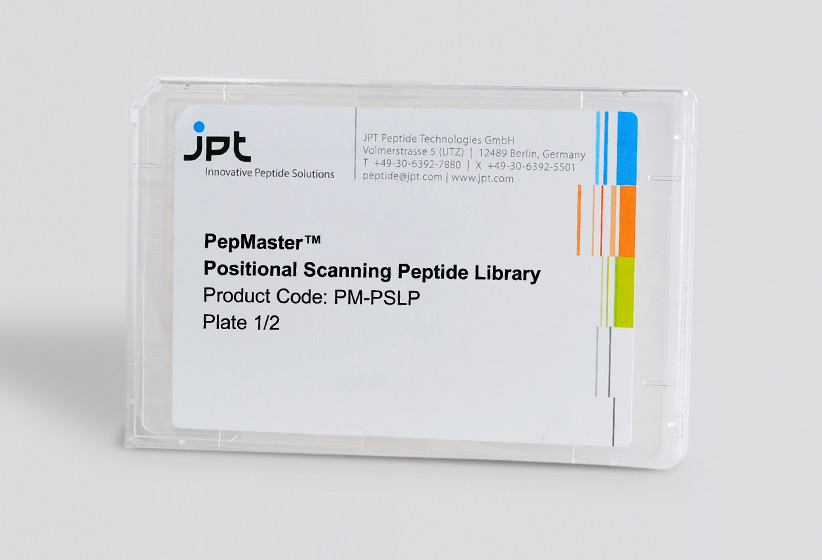
PM-PSPL
PepMaster Positional Scanning Peptide Library


Quality Assurance
All production is ISO 9001:2015 certified.
Positional scanning peptide library with 181 different peptide mixtures to identify stimulating peptides for T-cell clones. Each mixture contains a very large number of 9mer peptides that are identical with respect to one single, fixed amino acid position but are variable with respect to all other positions.
Additional information on generation and use of Positional Scanning libraries
Are you interested in your own custom PepMix? Choose your sequence, amount, purity and pool format. We will assist you along the way. Custom PepMix Peptide Pools.
PepMaster™ Positional Scanning Peptide Library
PepMaster™ offers 181 different peptide mixtures to identify stimulating peptides for T-cell clones. Each mixture contains a very large number of 9mer peptides that are identical with respect to one single, fixed amino acid position but are variable with respect to all other positions. This creates peptides, for example, of the format ‘A1-X2-X3-X4-X5-X6-X7-X8-X9’, ‘X1-A2-X3-X4-X5-X6-X7-X8-X9, ‘X1-X2-A3-X4-X5-X6-X7-X8-X9’, etc., where ‘A’ represents alanine, and ‘X’ represents any amino acid except cysteine (to prevent oligomerization or cyclization). The ability of a specific T-cell receptor (TCR) to recognise, for example, the ‘X1-A2-X3-X4-X5-X6-X7-X8-X9’ library depends on the preference of this TCR for ‘A’ in position 2 of the peptide chain. PepMaster™ is used like a PepMix™, however, the ideal concentrations should be determined as they depend on the purpose and design of the experiments.
Benefits of JPT’s PepMaster™ Positional Scanning Peptide Library
- Effective tool to measure T cell specificity
- Whole production performed in a regulated European environment according to ISO 9001:2015
- Synthesis protocols designed to avoid toxic contaminants and side products
References:
Read more References
| Properties | Values |
|---|---|
| Amount: | 440 µg /pool |
| Application: | Enzymology, T-cell immunity |
| Category: | PepMix Peptide Pools, PepMix Peptide Pools other Antigens |
| Condition / Topic: | Autoimmune disease, Cancer, Control, Infection |
| Layout: | 96 well microtiter plate |
| Organism: | Other/None |
| Protein Name: | Other |
| Purity: | crude |
| Quantification: | Yes |
| Information | Values |
|---|---|
| Specifications: | 9mer peptides |
All production is ISO 9001:2015 certified.
Check our list of products, click and go.
Get a quote